Monitoring & Alerts
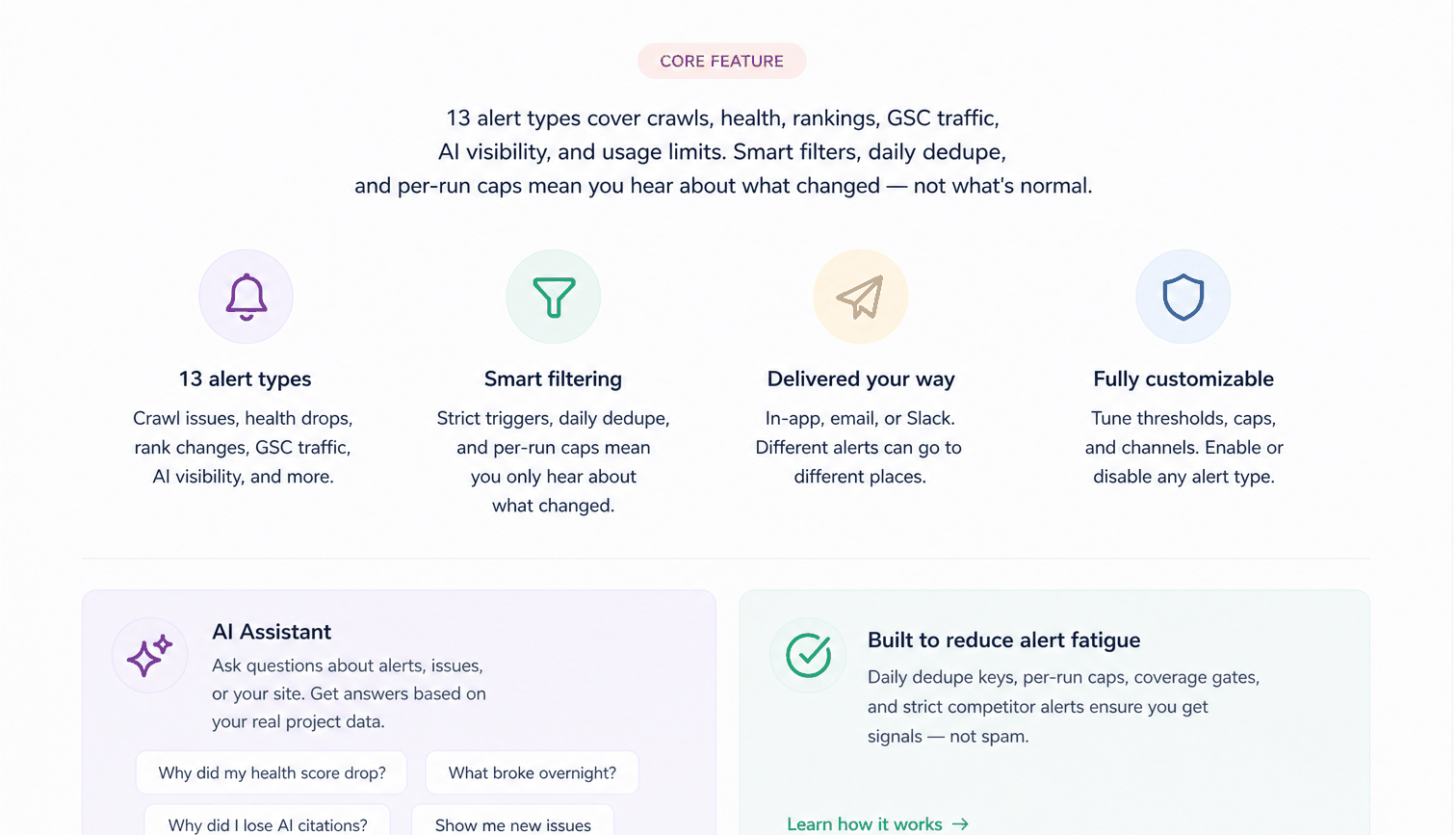
Alerts cover crawls, health, ranks, GSC traffic, AI Visibility, and usage limits. Strict triggers, daily dedupe, and per-run caps mean you hear about what changed. Not what's normal.
Alert types
Each type carries its own default threshold, dedupe key, and per-run cap. Tunable per workspace. Turn any of them off if they're not useful.
Crawl completed
Fires when a scheduled crawl finishes successfully. Useful for confirming overnight runs.
New broken pages
Fires when a crawl detects new 404/410/5xx URLs that weren't broken before. Diff-based; doesn't repeat for unchanged failures.
Crawl failed
Fires when a crawl can't start or aborts mid-run. Includes the failure reason and a link to retry.
Health score drop
Fires when your project's overall health score falls by ≥10 points sync-over-sync. Threshold tunable per workspace.
New issues spike
Fires when a crawl detects ≥20 new issues that weren't in the prior crawl. Helps catch deployments that introduce regressions.
GSC traffic drop
Fires when Google Search Console clicks drop ≥20% week-over-week with a baseline of ≥50 clicks (avoids tiny-volume flap).
Keyword rank drop (aggregate)
Fires when 3+ tracked keywords each drop 5+ positions on the same project. Project-level early warning.
Keyword rank drop (per-keyword)
Fires for an individual keyword's significant drop. Top-10 exit, top-20 exit, or absolute position drop. Capped at 20 alerts per project per run.
Usage limit warning
Fires at 80% of any plan limit (crawls, pages, AI credits, etc.) so you can upgrade before you hit a wall.
Usage limit reached
Fires when a plan limit hits 100%. Includes the resource and a one-click upgrade link.
AI Visibility drop
Fires when your project's AI Visibility Score regresses ≥10 points sync-over-sync. Requires ≥10 enabled prompts on both windows to avoid tiny-project flap.
Lost AI citation
Fires when a prompt was MENTIONED_CITED on the prior weekly AI Visibility sync and is now any weaker status. Capped at 10 per project per run, sorted by AI search volume.
AI competitor takeover
Fires only on strict displacement. You were cited, now you're not, and a known competitor is. The looser "any new competitor mention" version isn't included; too noisy.
Three delivery channels
Configure channels per alert type. Different alerts can go to different places. Health-score drops to Slack, usage limits to email, the rest in-app only.
In-app
Notification dropdown in the header + a full alerts page with filters and history.
Sent via Resend with type-specific templates. Defaults on; opt out per alert type.
Slack
Available on Pro and Enterprise. Connects via Slack OAuth; alerts post to a channel of your choice.
How CrawlTide avoids alert fatigue
Daily dedupe keys
Every alert carries a deduplication key like ai_lost_citation:promptId:date. Repeat conditions on the same day reuse the same alert instead of spawning a new one.
Per-run caps
Per-prompt and per-keyword detectors cap at 10–20 alerts per run. The most impactful items surface first (sorted by traffic/volume) and the rest wait for the next cycle.
Coverage gates
Score-drop alerts require minimum prompt or click coverage so a one-prompt project flipping from cited to not-cited doesn't dominate the inbox.
Strict triggers
Competitor takeover only fires on actual displacement (you were cited, you're not, and a competitor is). Looser "any new competitor mention" versions are deliberately not included. Too noisy.
Per-workspace preferences
Disable any alert type entirely. Tune thresholds. Pick channels. Each workspace owns its own monitoring config.
Plus log file analysis
On Standard and above, upload Apache, Nginx, or CloudFront access logs to surface real bot crawl behavior. What Googlebot actually fetched, where it 404'd, and which URLs are being wasted on duplicate parameters. Not part of the alerts pipeline; lives alongside it.
Available on every plan
Alerts ship on Free and above. Email and in-app are universal. Slack channel delivery is gated to Pro and Enterprise. Log file analysis ships on Standard and above.
Compare plans →Related features
Hear about what changed, ignore what didn't
Alerts ship on every plan. Slack delivery and log file analysis unlock on Pro.
Start free