Keyword Research for Beginners: How to Find SEO Keywords That Drive Traffic
Last updated: October 16, 2026
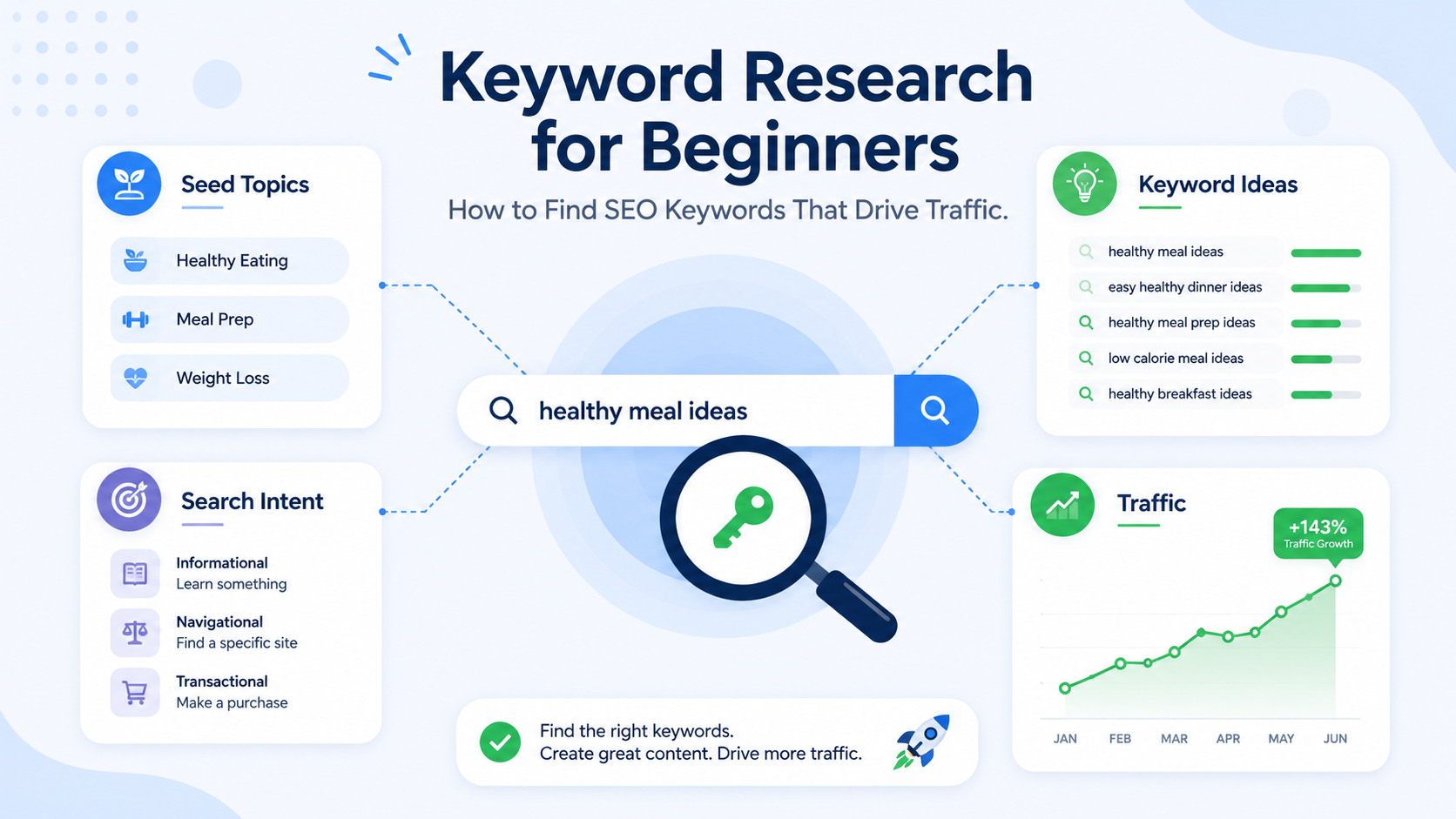
Table of Contents
- What keyword research actually does
- How many core topics should you start with?
- How do you get keyword ideas?
- Understand search intent before you write
- Informational
- Navigational
- Commercial investigation
- Transactional
- Check whether the topic is realistic
- Group keywords into topics, not random posts
- Build your article around the primary keyword naturally
- Does keyword research only apply to blog posts?
- A simple keyword research workflow for beginners
- Step 1: Pick one core topic
- Step 2: Gather keyword variations
- Step 3: Identify the dominant intent
- Step 4: Review the search results
- Step 5: Choose one primary keyword
- Step 6: Group supporting keywords
- Step 7: Create the outline
- Step 8: Publish and improve
- Can you do keyword research in 90 minutes?
- Common keyword research mistakes beginners make
- Chasing only high-volume keywords
- Ignoring intent
- Publishing one page per tiny variation
- Writing for tools instead of humans
- Choosing topics unrelated to the product or audience
- How CrawlTide can help
- Why this beats chasing search volume
Keyword research for beginners comes down to five steps: pick one core topic, list the phrases people search around it, check the intent behind each phrase, review what already ranks, and group related phrases so one strong page covers them. That process stops you writing content nobody searches for, which is the most common reason SEO content fails.
That is where keyword research helps. CrawlTide’s Keyword Intelligence feature can also help you research keywords, evaluate related terms, track rankings, and organize keyword opportunities over time.
Keyword research is the process of finding the words and phrases people type into search engines when they are looking for information, products, services, comparisons, or solutions. When you do it well, you stop guessing and start building content around real demand.
In this guide, you will learn a beginner-friendly process for finding SEO keywords that can drive traffic and lead to meaningful results.
What keyword research actually does
Keyword research helps you answer five practical questions:
What are people searching for?
Why are they searching for it?
How competitive is the topic?
Which related terms belong together?
What kind of page should you create to match the search?
Without these answers, it is easy to publish random articles and hope something works. With them, you can build a content plan around topics that have a real chance to perform.
How many core topics should you start with?
Start with one core topic and three to seven seed topics inside it. One core topic keeps your first articles focused and linked to each other; the seed topics are the main problems your audience wants solved within it. Add a second core topic only once the first has a main guide and a few supporting pages.
Every keyword strategy starts with a few broad ideas. These are usually the main problems your audience wants to solve.
For example, if you run an SEO platform, your seed topics might include:
keyword research
site audit
backlink analysis
on-page SEO
technical SEO
rank tracking
competitor analysis
You do not need a giant list at this stage. You only need a handful of starting points that reflect what your users care about.
A good rule is to ask: “What would someone search right before they discover they need our product?” That question often reveals the best content opportunities.
How do you get keyword ideas?
You get keyword ideas by expanding each seed topic into the exact phrases people search. Five free sources cover most of it: Google autocomplete, the "People also ask" box, the related searches at the bottom of the results page, the queries in your own Search Console, and a keyword tool such as the free keyword generator, which adds search volume and difficulty.
Once you have seed topics, turn them into more specific searches. If you want a repeatable way to do this, use a keyword research tool that can surface related terms, search volume, difficulty, and competition data from a seed keyword. Look for:
beginner queries
comparison queries
problem-solving queries
commercial investigation queries
long-tail variations
Examples from the seed topic “keyword research” could include:
keyword research for beginners
how to find SEO keywords
keyword research tips
how to do keyword research for a new website
free keyword research process
keyword clustering for SEO
how to find low competition keywords
Long-tail keywords matter because they are usually more specific, less ambiguous, and easier to match with focused content. They also tell you more about the searcher’s intent. As Ahrefs explains, long-tail keywords make up the majority of all searches and often convert better than head terms.
Understand search intent before you write
Search intent is the reason behind the query. You can also use CrawlTide’s free Keyword Intent Checker to classify a keyword as informational, commercial, transactional, navigational, or local before you choose the page type. This is one of the biggest differences between content that ranks and content that stalls. Google’s own helpful content guidelines emphasize creating content that satisfies the purpose behind a search.
Most keywords fall into one of these buckets:
Informational
The user wants to learn something. Examples: what is keyword research, how to do keyword research.
Navigational
The user wants a specific brand or page. Examples: ahrefs keyword research guide, crawltide pricing.
Commercial investigation
The user is comparing options before making a decision. Examples: best keyword research tools, ahrefs alternatives.
Transactional
The user is ready to take action. Examples: buy SEO software, sign up for keyword tool.
Before creating a page, check what is already ranking. If search results are dominated by beginner guides, a product landing page probably will not satisfy that intent. If results are mostly tool pages or comparison pages, a broad educational article may not be the best fit.
Check whether the topic is realistic
Beginners often choose keywords that are too broad too early.
A term like “SEO” may sound attractive, but it is incredibly broad and difficult to win with a new or smaller site. A phrase like “keyword research for beginners” is more focused and gives you a clearer angle.
When reviewing a keyword, ask:
Is the topic too broad?
Can I create something more useful than what already exists?
Does this keyword fit my audience?
Does ranking for it help the business?
Can I support it with related subtopics?
A keyword is not valuable just because it gets traffic. It has to bring the right kind of visitor.
Group keywords into topics, not random posts
One of the most common beginner mistakes is creating a separate article for every tiny variation. That leads to thin content, duplicate angles, and pages that compete with each other. Semrush calls this keyword cannibalization, and it can seriously hurt your rankings.
A better approach is to group related keywords into one core topic. If you already have a list of keyword ideas, CrawlTide’s Keyword Clustering Tool can group them into content clusters for blog posts, landing pages, and topic hubs.
For example, these terms can often live in the same article:
keyword research for beginners
how to find SEO keywords
beginner SEO keyword research
keyword research tips
Instead of writing four weak posts, create one genuinely useful guide that covers the topic well.
Then support it with related articles like:
long-tail keywords explained
search intent for SEO
keyword clustering guide
on-page SEO checklist
This creates a cleaner content structure and helps internal linking make more sense.
Build your article around the primary keyword naturally
Once you choose a primary keyword, use it in important places naturally:
title tag
page URL
main H1
introduction
at least one subheading where relevant
meta description
image alt text where appropriate
But do not force it. Good SEO writing is not about stuffing the same phrase into every paragraph. It is about covering the topic clearly, using natural language, and answering the questions a searcher is likely to have. The goal is to signal relevance without sacrificing readability.
Does keyword research only apply to blog posts?
No. Blog posts are only where the connection is easiest to see. Every page type that can be found in search deserves the same intent check:
The pattern is the same everywhere: find the phrase, read the intent behind it, then pick the page type that satisfies that intent.
Landing pages - target the commercial phrase people use when they are ready to act, not the broad informational term. "Keyword research tool" belongs here, "what is keyword research" does not.
Category pages - usually your strongest candidates for broad head terms, because a category naturally covers a whole topic rather than one slice of it.
Product and service pages - match the words buyers actually use, including the ones that name a problem rather than your product.
Comparison pages - built around "x vs y" and "best x for y" searches, where the reader is choosing between options rather than learning a concept.
Site structure itself - your keyword groups are a map of how sections and internal links should be organized, before a single page is written.
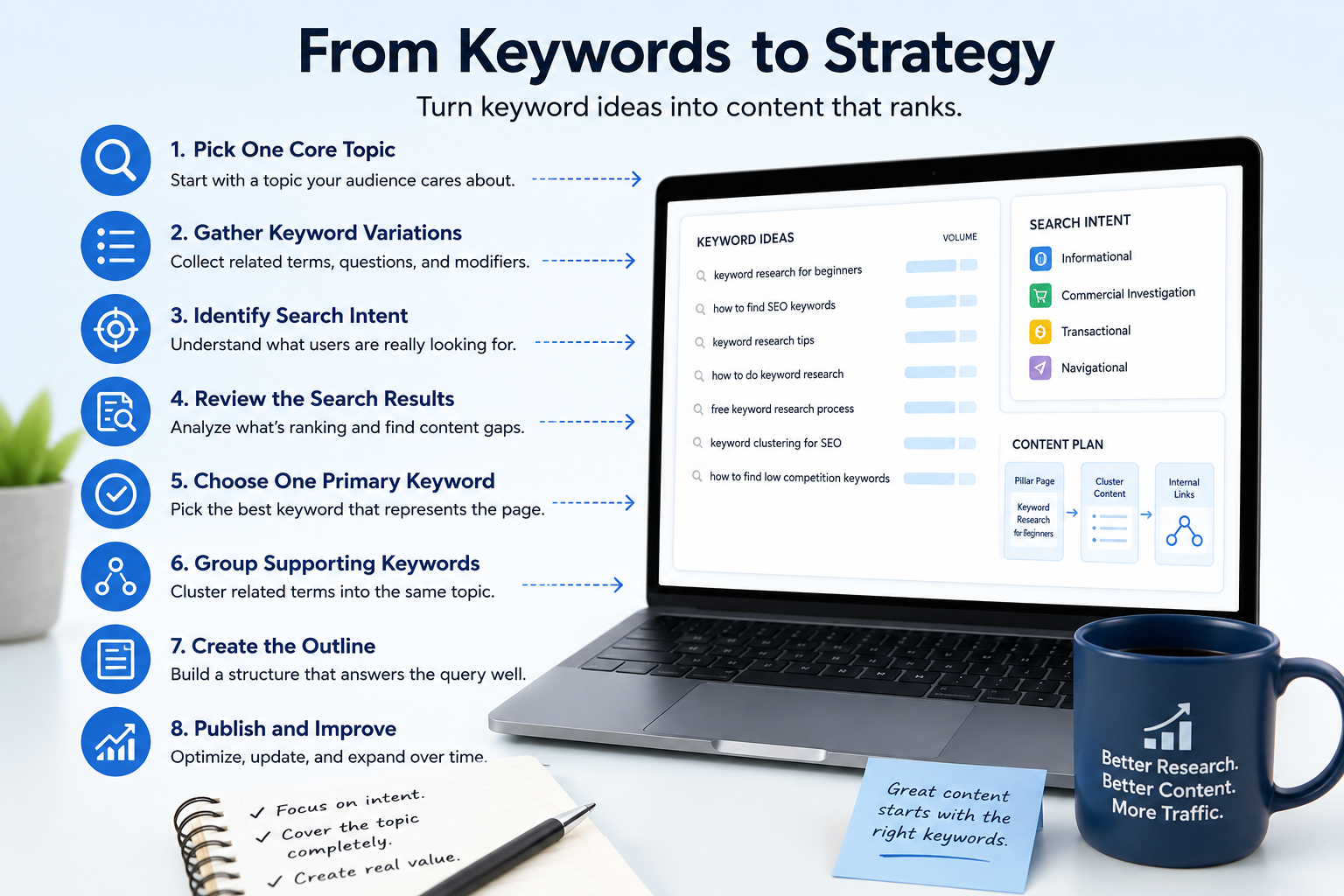
A simple keyword research workflow for beginners
Here is a practical process you can repeat:
Step 1: Pick one core topic
Choose a topic tightly related to your audience and offer.
Step 2: Gather keyword variations
List common questions, modifiers, and related long-tail phrases.
Step 3: Identify the dominant intent
Decide whether searchers want a guide, comparison, category page, tool, or landing page.
Step 4: Review the search results
Look at the top-ranking pages and note: content format, depth, recurring subtopics, gaps or weak points.
Step 5: Choose one primary keyword
Pick the clearest phrase that best represents the topic.
Step 6: Group supporting keywords
One of the most useful keyword research tips for beginners is to cluster related phrases before writing, so one strong page can cover the full topic instead of splitting authority across several thin posts.
Add closely related terms that belong in the same article.
Step 7: Create the outline
Make sure the structure answers the query completely and logically.
Step 8: Publish and improve
After publishing, refine internal links, update missing sections, and expand where the topic deserves more depth.
Can you do keyword research in 90 minutes?
Yes, for one topic. Ninety minutes is enough to go from a seed topic to a grouped keyword list and an outline for your first page, if you keep to one core topic and stop researching once each step is done.
Minutes 0 to 15: write down your core topic and three to seven seed topics.
Minutes 15 to 45: collect variations for each seed from autocomplete, "People also ask", related searches, Search Console and a keyword tool. Aim for 30 to 60 phrases.
Minutes 45 to 60: mark the intent of each phrase and search the five most promising ones to see what already ranks.
Minutes 60 to 75: group phrases that share an intent into clusters, and pick one primary keyword per cluster. The free keyword clustering tool does the grouping for you.
Minutes 75 to 90: outline the first page: title with the primary keyword, one section per supporting question, and the links to and from related pages.
The timer matters more than the exact split. Beginners lose most of their time collecting hundreds of keywords they never use.
Common keyword research mistakes beginners make
Chasing only high-volume keywords
A giant keyword is not automatically a good keyword. Relevance and intent matter more.
Ignoring intent
If the page type does not match the query, rankings usually struggle.
Publishing one page per tiny variation
This creates clutter and weakens topical focus.
Writing for tools instead of humans
Keyword placement matters, but clarity matters more.
Choosing topics unrelated to the product or audience
Traffic that does not connect to your business rarely turns into meaningful growth.
How CrawlTide can help
Keyword research gets easier when you can evaluate opportunities without bouncing between scattered spreadsheets, guesswork, and disconnected tools.
A strong workflow should help you:
discover keyword ideas
spot long-tail opportunities
understand intent
evaluate competition
organize topics into clusters
connect research to content planning
CrawlTide’s Content Studio can help turn research into content briefs, internal link suggestions, schema recommendations, and CMS-ready optimizations.
That is the difference between collecting keywords and building an SEO strategy. See what CrawlTide offers to support your keyword research workflow, or check out our guide to fixing crawl budget waste for another practical SEO walkthrough.
Why this beats chasing search volume
Keyword research is not about finding the biggest number and writing a quick article around it.
It is about understanding demand, matching intent, and creating content that deserves to rank.
If you start with the right topic, group related keywords intelligently, and build genuinely useful pages, you give your content a far better chance to earn traffic over time.
For beginners, that is the real win: less guessing, more clarity, and a smarter path to SEO growth.
CrawlTide Team
CrawlTide is an AI-powered SEO platform that helps teams find and fix technical SEO issues, track keyword rankings, and optimize search performance.
Suggested Reading

Free SEO Tools That Stay Free: A Stack Built by Job
A free SEO stack sorted by job, with what each tool asks of you (account, billing details, page caps), including the new free AI search reports in Google Search Console and Bing Webmaster Tools.
8 min read
Schema Markup Examples That Still Earn Rich Results in 2026
Google quietly retired HowTo and FAQ rich results, but most schema guides still recommend them. Here is which markup still renders, by page type, and how to check it before it ships.
9 min read
Schema Markup in SEO: What It Actually Does, and When It Quietly Stops Working
Schema markup in SEO earns rich result eligibility, not rankings. See what Google still renders and why valid markup silently breaks.
7 min read