What Is Keyword Intelligence? How It Works & Why It Matters
Last updated: October 15, 2026
Table of Contents
- What is keyword intelligence?
- What data does keyword intelligence use?
- How is keyword intelligence different from keyword research?
- How do you prioritize keywords with keyword intelligence?
- What does keyword intelligence look like in practice?
- Why do keyword tools and Search Console disagree?
- What are the most common keyword intelligence mistakes?
- How does keyword intelligence work for AI search?
- How do you start using keyword intelligence?
- Do you need a paid tool for keyword intelligence?
Keyword intelligence is the practice of combining keyword data (search volume, difficulty, search intent, who already ranks) with your own ranking data to decide which keywords to target next and what to do about each one. Keyword research gives you a list of terms; keyword intelligence tells you which of those terms you can actually win, and the next step for each.
This guide covers the data keyword intelligence uses, how it differs from plain keyword research, and a worked example from our own site.
What is keyword intelligence?
Keyword intelligence is keyword research plus context: it scores every keyword against your site's current position and your competitors, so the output is a prioritized action list rather than a spreadsheet of search volumes. A keyword with 5,000 searches a month is worthless to you if ten sites with far more authority hold the top results, and a keyword with 300 searches can be the best opportunity you have if you already rank twelfth for it.
The term covers both the method and the tools that automate it. Most SEO platforms use it loosely; what matters is whether the tool connects market data to your own data.
What data does keyword intelligence use?
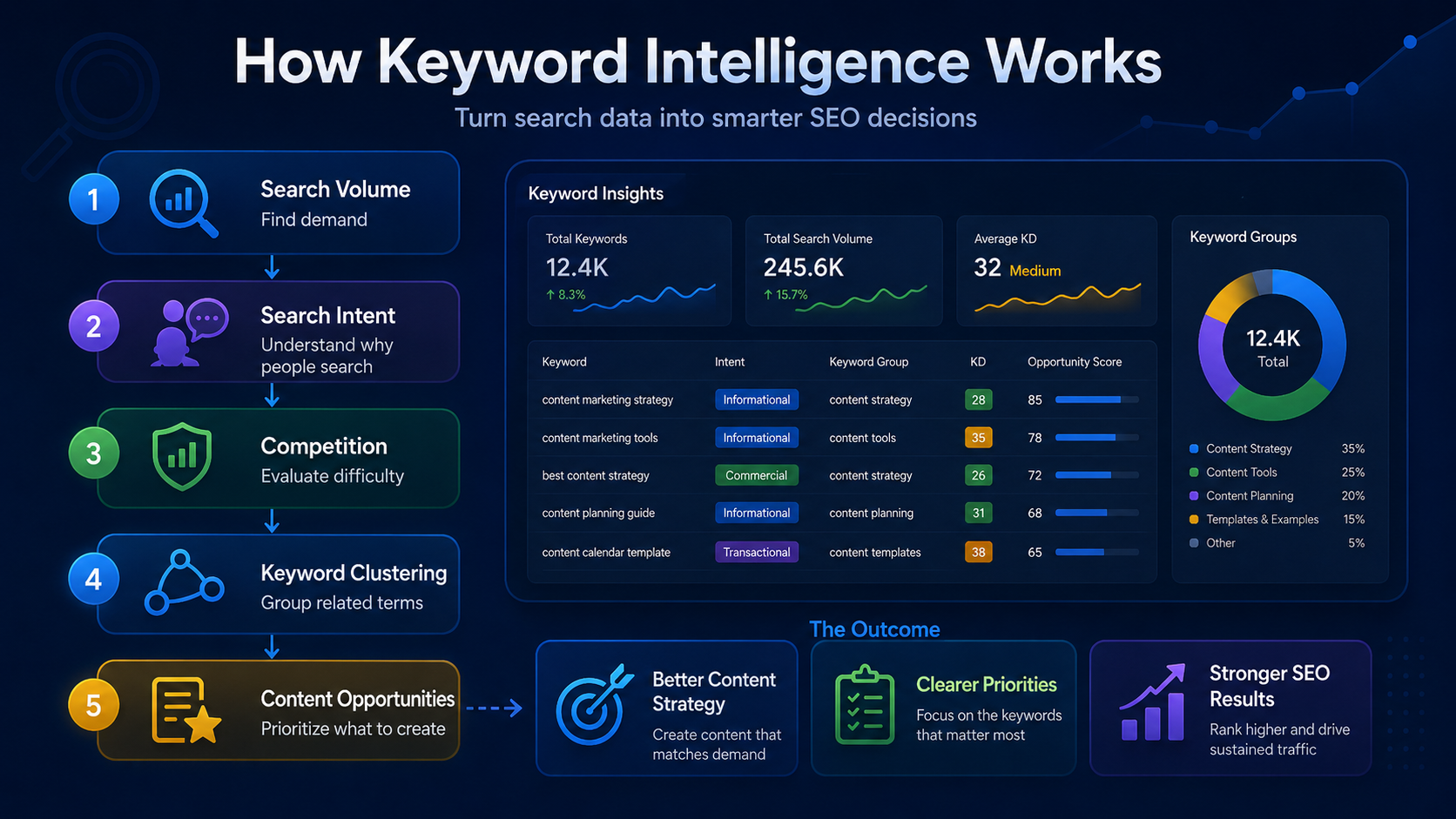
Keyword intelligence uses five kinds of data: search volume, keyword difficulty, search intent, the current results page, and your own rankings from Google Search Console. The first four describe the keyword; the fifth describes where you stand, and it is the one most keyword lists leave out.
Search volume: average monthly searches. It sizes the prize but says nothing about whether you can win it.
Keyword difficulty: a 0 to 100 estimate of how hard the top results are to displace, usually based on their backlinks.
Search intent: whether the searcher wants to learn, compare, buy, or reach a specific site. Intent decides the page type: a guide, a comparison, a product page or a tool. You can classify any keyword with the free keyword intent checker.
The results page: who ranks now, and which features appear (AI Overviews, video, local results). These change how many clicks a top position is worth.
Your own position and impressions: Search Console shows the queries Google already associates with your pages. A query where you sit at positions 8 to 20 is usually the cheapest win available.
How is keyword intelligence different from keyword research?
Keyword research finds keywords; keyword intelligence decides what to do with them. Research answers "what do people search for in my niche?" Intelligence answers "which of these should I work on this month, and should I write a new page, refresh an existing one, or leave it alone?"
In practice, the difference shows up in three decisions that a plain keyword list cannot make for you:
New page or existing page. If you already rank for a keyword, a new article usually competes with your own page. Refreshing the page that ranks is faster and safer.
Which keywords belong together. Variations such as "sitemap checker" and "xml sitemap checker" should be served by one page. A keyword clustering tool groups them so you do not split your effort.
What not to chase. High-volume keywords with difficulty far above your site's authority are a long-term project, not this month's work.
| Keyword research | Keyword intelligence | |
|---|---|---|
| Question it answers | What do people search for? | What should we work on next, and how? |
| Main data | Volume, difficulty, related terms | The same, plus your positions, impressions and current pages |
| Output | A list of keywords | A ranked list of actions: refresh, new page, build links, or skip |
| How often | At the start of a project | Every month, because positions move |
How do you prioritize keywords with keyword intelligence?
Prioritize keywords by where you rank now and how hard the keyword is, then pick the action that fits: refresh pages you already rank for, write new pages for winnable gaps, and leave out-of-reach keywords for later. Volume decides the order within each group, not which group comes first.
| Your position now | Difficulty vs your site | Best action |
|---|---|---|
| 4 to 10 | Any | Refresh the ranking page: sharpen the title, answer the query in the opening, add internal links to it |
| 11 to 20 | Low or similar | Refresh first; this is usually the best return of any keyword work |
| 11 to 20 | Much higher | Refresh, then earn links to the page; content alone rarely closes the gap |
| 21 to 100 | Low | Check intent: the page may be the wrong type for the query, and a dedicated page may win |
| Not ranking | Low | Write a new page, and link to it from related pages you already have |
| Not ranking | Much higher | Skip for now, or target narrower long-tail versions first |
Before acting on any row, check that only one of your pages targets the keyword. Two pages competing for the same query usually both rank worse than one would.
What does keyword intelligence look like in practice?
Here is a real example from crawltide.com in October 2026: Search Console showed our free sitemap and robots.txt tool at an average position of 12 for "sitemap checker", with 155 impressions in three months. The keyword gets about 720 searches a month in the U.S. with a difficulty of 10, and "xml sitemap checker" adds about 260 more at difficulty 1.
A keyword list would have shown "sitemap checker" as a medium-volume term. Combined with our own data, the decision was obvious: we were already on page two, competition was low, and the page's title led with "robots.txt" instead of the phrase people search for. The fix was a retitle and two answer-first sections on the existing page, not a new article.
The same review turned up the opposite case. "AI visibility" brought us over 3,000 impressions, but at an average position of 71. That is not a quick refresh; it needs a cluster of supporting articles and links over months.
Why do keyword tools and Search Console disagree?
Keyword tools estimate search volume from sampled data, so they often undercount niche and newer terms; Search Console impressions are Google's own count of how often your page appeared. When the two disagree, your impressions are the better guide to real demand.
This very article is an example. Our keyword data put "keyword intelligence" at about 20 searches a month. Search Console showed this page earning around 435 impressions in three months for "keyword intelligence" and "keywords intelligence" combined, about 145 a month, and that was while ranking on page two or three. A keyword list would have dismissed the topic as too small to bother with.
The disagreement also runs the other way. A keyword can show healthy volume in a tool and still send few clicks if an AI Overview or a featured snippet answers it on the results page. Check the live results before you commit to a high-volume informational keyword.
What are the most common keyword intelligence mistakes?
The most common mistake is choosing keywords by volume alone. The others follow from the same habit of looking at keyword data without your own data beside it.
Writing a new article for a keyword you already rank for. The new page competes with the old one, and neither wins. Refresh the page that ranks.
Ignoring intent mismatch. A product page will not rank for "what is" queries, and a guide will not rank for "best tool" queries that show comparison pages.
Treating difficulty as exact. Each tool calculates difficulty differently. Use it to compare keywords within one tool, not as an absolute score.
Checking once. Positions, results pages and competitors change every month. A review you never repeat goes stale within a quarter.
How does keyword intelligence work for AI search?
Keyword intelligence for AI search means checking whether ChatGPT, Gemini, Perplexity and Google's AI Overviews mention your site for the questions behind your keywords, not just where you rank. The same prioritization applies: start with the questions where you already appear in Google, because AI answers often draw on pages that rank well.
Pages that open each section with a direct, self-contained answer are easier for AI tools to quote, which is why every section of this article starts with one. To see how ready one of your pages is, run it through the free AI answer readiness checker.
How do you start using keyword intelligence?
Start with the keywords you already rank for, because they are the cheapest wins. Open Search Console, go to Performance, and filter for queries where your average position is between 8 and 20.
Export those queries and add search volume and difficulty from any keyword tool. The free keyword generator shows both.
Group variations of the same need, and note which of your pages ranks for each group.
For each group, check intent against the page type. A "how to" query landing on a product page needs a section that answers the question.
Fix the ranking page first: put the exact phrase in the title and first heading, and answer the question in the opening sentences.
Only then look for new keywords, using a content gap checker to find terms competitors rank for that you do not.
Repeat the review monthly. Positions move, and a keyword that was out of reach last quarter can drift into range.
Do you need a paid tool for keyword intelligence?
You do not need a paid tool to start: Search Console is free and holds the most valuable data, your own positions. Free tools cover volume, difficulty and intent for a handful of keywords at a time.
A paid platform helps once you track hundreds of keywords, because the work becomes joining datasets that live in different places. CrawlTide's keyword tools pull volume, difficulty and ranking pages from DataForSEO, combine them with your Search Console data, track positions over time, and save every search to your project so the list grows as you work.
CrawlTide Team
CrawlTide is an AI-powered SEO platform that helps teams find and fix technical SEO issues, track keyword rankings, and optimize search performance.
Suggested Reading

Free SEO Tools That Stay Free: A Stack Built by Job
A free SEO stack sorted by job, with what each tool asks of you (account, billing details, page caps), including the new free AI search reports in Google Search Console and Bing Webmaster Tools.
8 min read
Schema Markup Examples That Still Earn Rich Results in 2026
Google quietly retired HowTo and FAQ rich results, but most schema guides still recommend them. Here is which markup still renders, by page type, and how to check it before it ships.
9 min read
Schema Markup in SEO: What It Actually Does, and When It Quietly Stops Working
Schema markup in SEO earns rich result eligibility, not rankings. See what Google still renders and why valid markup silently breaks.
7 min read