Which SEO Visibility Tool Do You Need? Four Kinds, Compared
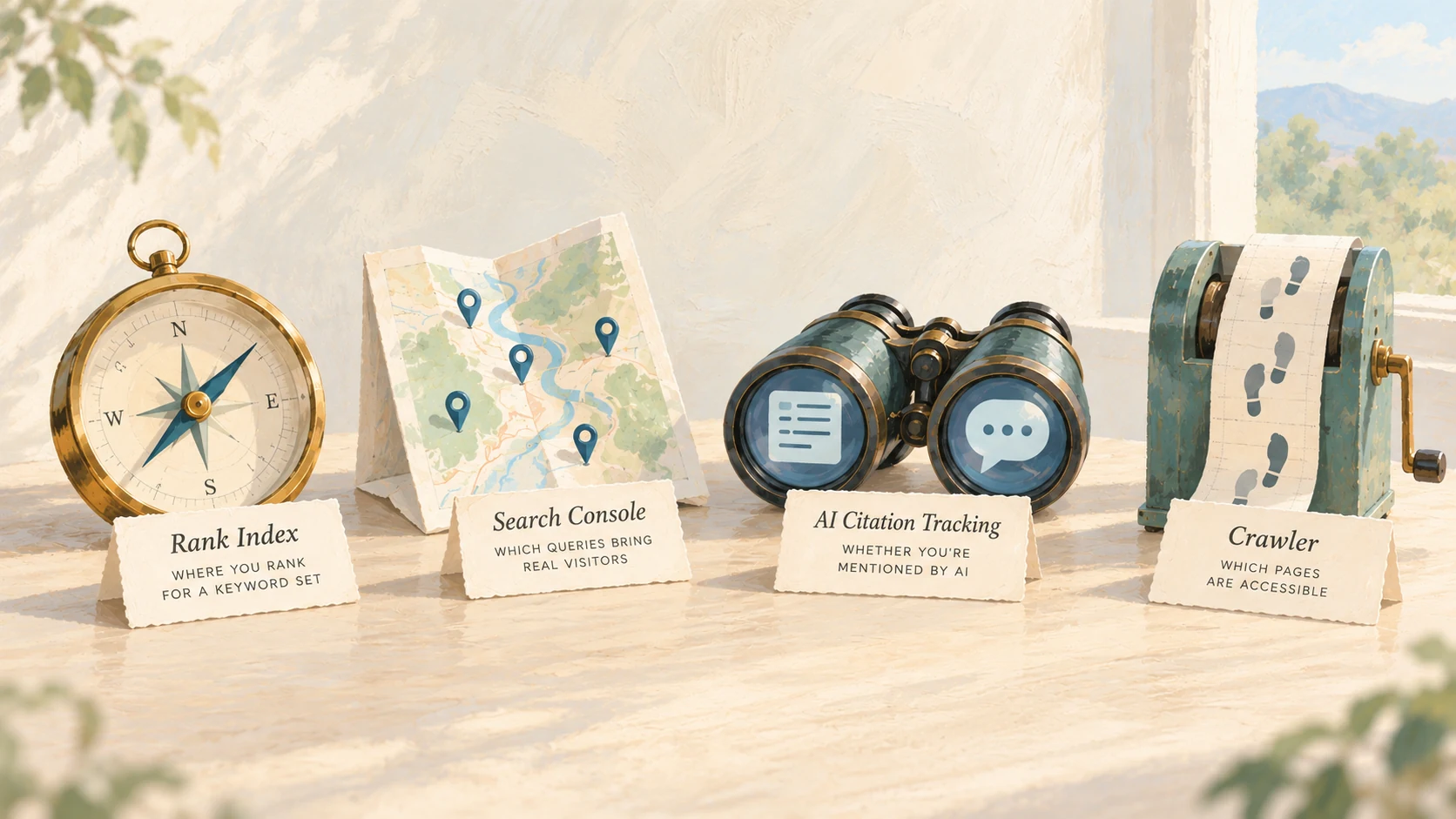
Table of Contents
- The four kinds of visibility tool, side by side
- Search Console is the only visibility data that comes from real searches
- How a rank tracker turns hundreds of positions into one score
- AI visibility trackers measure a moving target
- Crawlers answer the question that comes before visibility
- Is an SEO visibility score the same as AI visibility?
- Do you need a paid SEO visibility tool if you have Search Console?
- What CrawlTide covers, and what it leaves to Search Console
Search for "SEO visibility tool" today and most of page one is lists of AI visibility trackers, which is an odd answer to a question that used to mean one thing: how much of the search results do I own? Both readings are legitimate, and the tools behind them measure completely different things. Pick the wrong SEO visibility tool and you can spend a quarter reporting a number that cannot move the metric you actually care about.
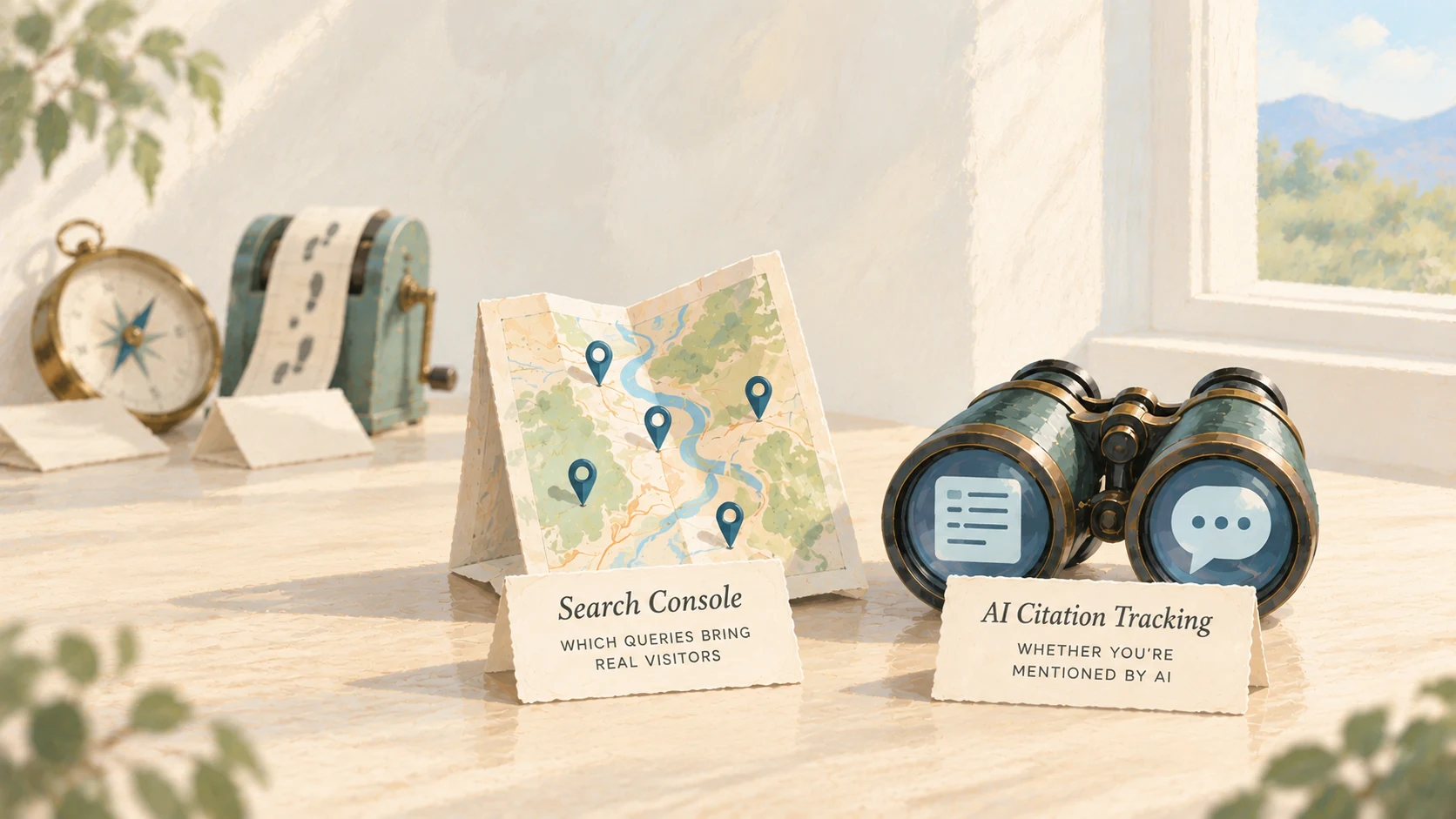
Four kinds of tool hide under the label. Each builds its number differently, and each has a specific way of misleading you if you read that number naively.
The four kinds of visibility tool, side by side
| Tool type | What it measures | Where the data comes from | How it misleads you |
|---|---|---|---|
| Google Search Console | Impressions, clicks, CTR and average position for queries you actually appeared on | Google's own record of real searches | Average position gets worse when you start appearing for new, low-ranking queries, even while traffic grows |
| Rank tracker visibility index | An estimated share of clicks across a keyword list you choose | Scheduled results-page checks from a set location and device | The score depends on which keywords you track: add weak ones and it falls with no change in traffic |
| AI visibility tracker | Whether AI answers mention or cite your brand for a set of prompts | Prompts sent to engines such as ChatGPT and Google AI Overviews | A single run of a non-deterministic system looks precise but is not |
| Site crawler | Whether your pages can be crawled, indexed and understood at all | Crawling your own site | A clean audit proves eligibility, not ranking |
Most teams need two of these, not four. The sections below cover how each number is built, so you can tell which two.
Search Console is the only visibility data that comes from real searches
Every other SEO visibility tool in the table simulates or samples. Search Console reports what Google logged. Google defines an impression as "how often someone saw a link to your site on Google", and position as the topmost position your link occupied, averaged across all queries (see Google's Search Console help page on impressions, position, and clicks).
That averaging is the trap. Imagine a site ranking around 4th for 20 queries. It publishes a new guide, and the guide starts appearing around position 60 for 200 long-tail queries. The original rankings hold, so traffic does not fall, yet the site-wide average position slides sharply toward 60. Read the average in isolation and a good month looks like a bad one.
Filter by page or query before you read position. For a new page, watch impressions first: they rise as soon as the page starts appearing for new queries, well before it earns clicks.
What Search Console cannot do is just as important. It shows no competitors, no queries you never appeared for, and nothing about AI answers.
How a rank tracker turns hundreds of positions into one score
A visibility index compresses a keyword list into one percentage. The exact recipe varies by vendor, but the shape is usually the same:
- Take every keyword in your tracked list and its monthly search volume.
- Look up the click-through rate the tool assumes for your current position on each one. Every vendor uses its own curve.
- Multiply volume by that rate to get estimated clicks per keyword, then add them up.
- Divide by the clicks you would get if you ranked first for every keyword.
Here is a worked illustration with made-up curve figures, since no two vendors publish the same curve. Say the curve gives position 1 a 30 percent click-through rate and position 8 a 3 percent rate. You track two keywords at 1,000 searches a month each, ranking 1st on one and 8th on the other. Estimated clicks are 300 plus 30, against a maximum of 600, so your visibility is 55 percent.
Now add ten keywords you rank 90th for, each also at 1,000 searches. Your estimated clicks stay at roughly 330, but the maximum jumps to 3,600. Visibility drops to about 9 percent. Nothing about your traffic changed; you changed the denominator.
A visibility score describes your keyword list as much as your site. Freeze the list before comparing months, and when you do add keywords, note the date so nobody reads the drop as a penalty.
Two more limits are worth knowing. Checks run on a schedule from one location and device type, so local and personalised results can differ from what your customers see. And a fixed curve treats position 1 under an AI Overview the same as position 1 on a plain results page, even though the answer box now sits above it.
If you are weighing the big all-in-one suites specifically, our head-to-head pages compare CrawlTide with Ahrefs and CrawlTide with Semrush feature by feature.
AI visibility trackers measure a moving target
AI visibility tools send prompts to engines like ChatGPT and Google AI Overviews and record whether your brand is mentioned, cited as a source, both, or neither. That signal matters. An answer that names three competitors and not you loses a buyer who never reaches a results page. If the concept is new to you, our explainer on what AI visibility is and how to check it covers the basics.
The catch: answers change between runs. A 2026 arXiv paper by Ronald Sielinski, "Quantifying Uncertainty in AI Visibility", sampled citations from Perplexity, OpenAI's SearchGPT and Google Gemini repeatedly, once a day over nine days and again at ten-minute intervals. It found that "many apparent differences between domains fall within the noise floor of the measurement process" and concluded that single-run metrics give "a misleadingly precise picture of domain performance."
The tool roundups currently ranking for this query compare engine coverage, sentiment and pricing. None of the three we read explain how many times a prompt is run before a score is reported. Ask any AI visibility tracker these questions before you pay for it:
- How many times is each prompt run per measurement, and is the reported figure an average across runs?
- Which engines does it query, and which model or mode? A result from one engine tells you nothing about another.
- Can you see the raw answer text, or only a score?
- Can you write your own prompts? Generic vendor prompts rarely match how your buyers phrase their questions.
If you plan to test changes yourself, our guide to running an AI visibility test without fooling yourself covers baselines, controls and why three hits out of five is too small a sample to call a win.
Crawlers answer the question that comes before visibility
A page Google cannot index has zero visibility in every other tool on this list. Crawlers check status codes, noindex tags, canonical tags, robots.txt rules and internal links, and they report problems rather than a visibility number. That is the right design: a clean audit proves a page is eligible to rank, nothing more.
Make a crawl your first check whenever a visibility number drops without an obvious cause. A single page can be tested in seconds with a free indexability checker before you start rewriting content that was never the problem.
Is an SEO visibility score the same as AI visibility?
No. An SEO visibility score estimates your share of clicks from ranked links, while AI visibility records whether generated answers mention or cite you, and the two can move independently. We saw this on our own site: when we audited CrawlTide for AI visibility, schema coverage went from 40 percent to 98 percent and our readiness score climbed, yet we still were not showing up in AI answers. Improving one set of signals did not move the other.
So report them separately. A single blended "visibility" number hides which of the two actually changed.
Do you need a paid SEO visibility tool if you have Search Console?
That depends on the question you need answered this month.
- One site, modest keyword ambitions: Search Console plus a crawler covers most of it. Filter by page and query, and watch impressions on new content.
- A freelancer or agency reporting to clients: a rank tracker earns its cost, because clients want competitor comparisons and a trend line that Search Console cannot provide. Freeze each client's keyword list.
- A team whose buyers ask ChatGPT before they search: add an AI visibility tracker, write your own prompts, and report a range across repeated runs rather than one percentage.
What CrawlTide covers, and what it leaves to Search Console
CrawlTide puts three of the four kinds in one account: daily rank tracking with results-page snapshots, a site crawler that flags 25+ issue types, and AI visibility tracking across ChatGPT and Google AI Overviews. Each tracked prompt gets one of four statuses: mentioned and cited, mentioned, source only, or not found. The Standard plan includes 75 tracked prompts and Pro includes 150.
It does not replace Search Console, which remains the only source of real impression data, so keep both open. For a quick start, run one of your key pages through the free AI visibility check and compare the result with that page's Search Console queries. Where the two disagree is where to look first.
CrawlTide Team
The CrawlTide Team builds and maintains CrawlTide, a platform for technical SEO audits, keyword research, content opportunities, and AI visibility tracking.
Suggested Reading

Free SEO Tools That Stay Free: A Stack Built by Job
A free SEO stack sorted by job, with what each tool asks of you (account, billing details, page caps), including the new free AI search reports in Google Search Console and Bing Webmaster Tools.
8 min read
Schema Markup Examples That Still Earn Rich Results in 2026
Google quietly retired HowTo and FAQ rich results, but most schema guides still recommend them. Here is which markup still renders, by page type, and how to check it before it ships.
9 min read
Schema Markup in SEO: What It Actually Does, and When It Quietly Stops Working
Schema markup in SEO earns rich result eligibility, not rankings. See what Google still renders and why valid markup silently breaks.
7 min read