What Is AI Visibility? How to Check If Your Website Shows Up in AI Search
Last updated: August 2, 2026
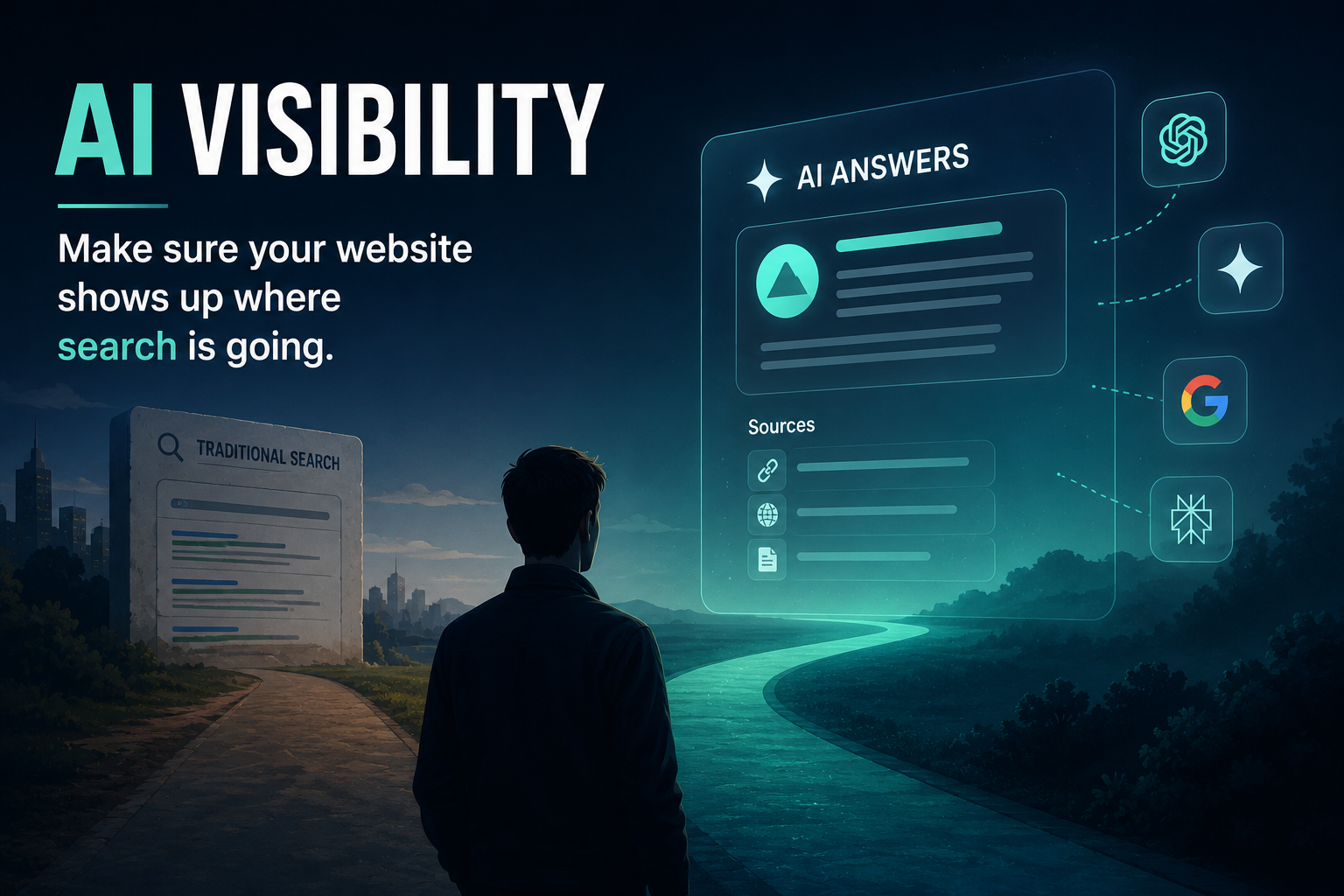
Table of Contents
- What AI visibility means
- Why this matters for SEO right now
- Where AI visibility shows up
- How to check if your website shows up in AI search
- 1. Search for your brand and category prompts manually
- 2. Compare your presence against competitors
- 3. Run a page-level readiness check
- 4. Review your technical SEO foundation
- 5. Monitor visibility over time
- What affects AI visibility
- Common reasons websites do not show up in AI search
- How CrawlTide helps track and improve AI visibility
- Start tracking before the gap widens
Your site ranks on page one for your target keyword, but when someone asks ChatGPT "what are the best tools for X," you are nowhere in the answer. That gap between traditional rankings and AI-generated results is AI visibility, and it is becoming the metric that separates brands people discover from brands people skip.
Search is no longer limited to ten blue links. AI-generated answers now mention brands directly, cite sources, summarize pages, and influence which companies get considered first. If your website does not show up in those answers, you may be losing ground even when your organic metrics look healthy.
What AI visibility means
AI visibility is the extent to which your brand, website, or content appears in AI-generated search experiences. That can include direct brand mentions, linked citations, source references, or cases where your domain is surfaced as supporting evidence inside an AI-generated response.
There are four distinct AI visibility states worth tracking:
Mentioned + Cited - your site is named and cited as a source
Mentioned - your brand appears in the answer but without a source link
Source Only - your URL appears in the source list but your brand is not named in the response
Not Found - your site does not appear in the response or sources for a given prompt
These distinctions matter because they point to different optimization opportunities. A brand that is cited but not named has a different fix path than a brand that is not found at all. "Source Only" often means the AI trusts your content but does not associate it with a clear entity, which is usually a schema or brand-signal problem, not a content problem.
Why this matters for SEO right now
Traditional SEO is still essential, but it no longer tells the whole story.
Discovery is shifting earlier in the funnel. People increasingly ask AI tools broad, intent-rich questions: "What are the best SEO tools?" or "How do I fix crawl budget waste?" or "Which platform helps with AI Overviews?" If your site is absent from those answers, you are invisible at the exact moment someone is forming a shortlist.
Brand presence is becoming part of search trust. AI systems do not just retrieve pages. They synthesize signals from content, structure, source quality, and topical authority. Consistent presence in relevant AI answers reinforces recognition in a way that a page-two ranking does not.
Rankings alone do not explain the full search landscape. A page can perform reasonably well in organic search and still be completely absent from AI-generated results. When we ran crawltide.com through our own AI Visibility feature, we tracked 15 prompts across five engines (Google AIO, ChatGPT, Claude, Gemini, and Perplexity). Our Readiness Score came back at 90 out of 230 points, which meant the technical foundation was decent but actual prompt-level visibility was weak: a score of 29 out of 100. The site was simply not being mentioned or cited for prompts we should have owned. That disconnect between page-level readiness and real AI presence is something traditional SEO metrics will never surface.
Where AI visibility shows up
AI visibility spans several environments, each with different behavior.
ChatGPT and answer engines surface brands in recommendation-style answers, explainers, and comparative responses. These are often the first place a buyer encounters a brand they have never searched for directly.
Google AI Overviews generate summaries above or alongside traditional listings. If your content is strong enough to be cited or referenced there, your brand can appear before anyone scrolls to the organic results.
Single-page readiness diagnostics focus on whether one page has the structural signals AI engines are likely to trust: JSON-LD, headings, trust links, canonical tags, and content depth. These are useful for page-by-page fixes, but they are not the same as tracking real prompt outcomes across a whole domain.
How to check if your website shows up in AI search
The simplest way to start is to combine manual prompt testing with structured diagnostics and ongoing tracking.
1. Search for your brand and category prompts manually
Start with prompts that reflect how buyers or researchers actually search:
best SEO tools for startups
how to improve AI search visibility
technical SEO audit tools
alternatives to [competitor name]
Look for whether your brand is named directly, cited as a source, shown only in source lists, or missing entirely. This gives you a first-pass view of where you stand.
2. Compare your presence against competitors
AI search is relative. If your competitors are repeatedly mentioned for prompts you care about and you are not, the issue is not visibility in isolation. It is lost market share inside AI-generated search experiences. Track competitor presence alongside your own results so you can see the gaps.
3. Run a page-level readiness check
Check your most important pages for the machine-readable signals AI engines tend to rely on: entity clarity, topical positioning, content structure, JSON-LD, trust signals, crawlability, title and meta alignment, and authority hints. CrawlTide's free AI Visibility Check scores a single page against these criteria and returns prioritized fixes.
4. Review your technical SEO foundation
A weak technical foundation reduces the chances that AI systems interpret your site cleanly. Missing meta tags, duplicate content, redirect chains, and orphan pages all create noise that makes it harder for AI engines to understand what your site is about and whether it should be trusted. Strengthening those basics supports both classic SEO and AI visibility.
5. Monitor visibility over time
AI visibility is not a one-time snapshot. Prompt landscapes change. Competitors publish new content. AI systems update what they surface. You need ongoing tracking of real prompt outcomes rather than occasional manual checks to catch shifts before they become gaps.

What affects AI visibility
The strongest factors usually come down to five areas.
Clear entity and brand signals. AI systems need confidence that your site represents a real, understandable entity. Organization schema, consistent NAP data, an about page, and clear brand positioning all contribute.
Strong content structure. Pages with descriptive headings, clear topical sections, supporting context, and strong page organization are easier for both humans and machines to interpret. Walls of text with vague headings are harder for AI systems to parse into useful answers.
Technical crawlability and indexability. Canonical tags, language declarations, structured metadata, and clean page accessibility make it easier for AI systems and search engines to process your pages correctly. These are foundational, not optional.
Topical authority. If your site has one thin page on a topic, it is less likely to be chosen than a site with deeper coverage, supporting articles, comparisons, and strong internal linking. Breadth and depth both matter.
Trust and supporting signals. About pages, contact pages, social profiles, schema, and consistent branding all contribute to whether an AI engine feels comfortable surfacing your content. These are the same signals that support E-E-A-T in traditional search.
Common reasons websites do not show up in AI search
If your site is missing from AI-generated answers, there is usually a specific reason.
Thin or generic content. If your pages do not say anything distinctive or specific, they are less likely to be surfaced as useful evidence. AI systems prefer content that actually answers the question over content that talks around it.
Weak page structure. Vague headings and unclear topic sections make pages harder for AI systems to parse into the structured snippets they use to build answers.
Missing trust or schema signals. JSON-LD, trust links, canonical tags, and topical alignment are scoring factors for AI readiness. Missing these reduces your page's chances of being cited.
Poor technical hygiene. Broken pages, redirect problems, duplicate content, and crawl issues reduce how clearly your site is processed. If the AI cannot cleanly crawl and interpret your pages, it will not cite them.
Competitors have stronger topical depth. Sometimes the problem is not your page quality alone. Another site has broader, clearer, better-connected coverage across the same topic space.
How CrawlTide helps track and improve AI visibility
CrawlTide separates two layers of AI visibility that are often confused: page-level readiness and real prompt-level presence.
The free AI Visibility Check evaluates a single page for the structural and trust signals AI engines use to decide whether to cite a source. It does not query ChatGPT or Perplexity directly. Instead, it scores the page against citation-related criteria and returns prioritized fixes you can act on immediately.
The full AI Visibility feature goes further. It tracks how your domain appears in real AI prompts and responses across five engines, monitors competitor presence, discovers prompts through both keyword-based and domain-based discovery, and measures site-wide readiness over time. You can see where your brand is already present and, more importantly, where you are missing entirely.
That workflow becomes more practical when combined with the rest of the platform:
Site Audit catches the technical blockers that reduce AI crawlability
Content Studio helps improve page structure and depth for the pages AI engines are most likely to evaluate
Keyword Intelligence identifies supporting topics and prompt-aligned content opportunities
Action Items turns findings into a prioritized fix list so improvements do not stall at the insight stage
Start tracking before the gap widens
AI visibility is not a replacement for SEO. It is an extension of it. If your brand is hard to understand, your pages are technically weak, or your topical coverage is shallow, AI systems are less likely to mention or cite you. But if your site is clear, trustworthy, well-structured, and strong across a topic, you have a much better chance of showing up where modern search is increasingly happening.
The earlier you understand how your site appears in ChatGPT, Google AI Overviews, and similar environments, the easier it becomes to close the gap before competitors take the lead.
Start with the free AI Visibility Check for a single-page score, then explore AI Visibility to track real prompts, competitor mentions, and site-wide readiness over time.
CrawlTide Team
CrawlTide is an AI-powered SEO platform that helps teams find and fix technical SEO issues, track keyword rankings, and optimize search performance.
Suggested Reading

Free SEO Tools That Stay Free: A Stack Built by Job
A free SEO stack sorted by job, with what each tool asks of you (account, billing details, page caps), including the new free AI search reports in Google Search Console and Bing Webmaster Tools.
8 min read
Should You Add an llms.txt File? What It Does and When It Pays Off
llms.txt is an emerging file that maps your best pages for AI engines. What it does, who actually honors it today, and how to write one in an hour.
7 min read
Schema Markup Examples That Still Earn Rich Results in 2026
Google quietly retired HowTo and FAQ rich results, but most schema guides still recommend them. Here is which markup still renders, by page type, and how to check it before it ships.
9 min read