What a Search Engine Visibility Tool Actually Measures (and Why Two Tools Disagree)
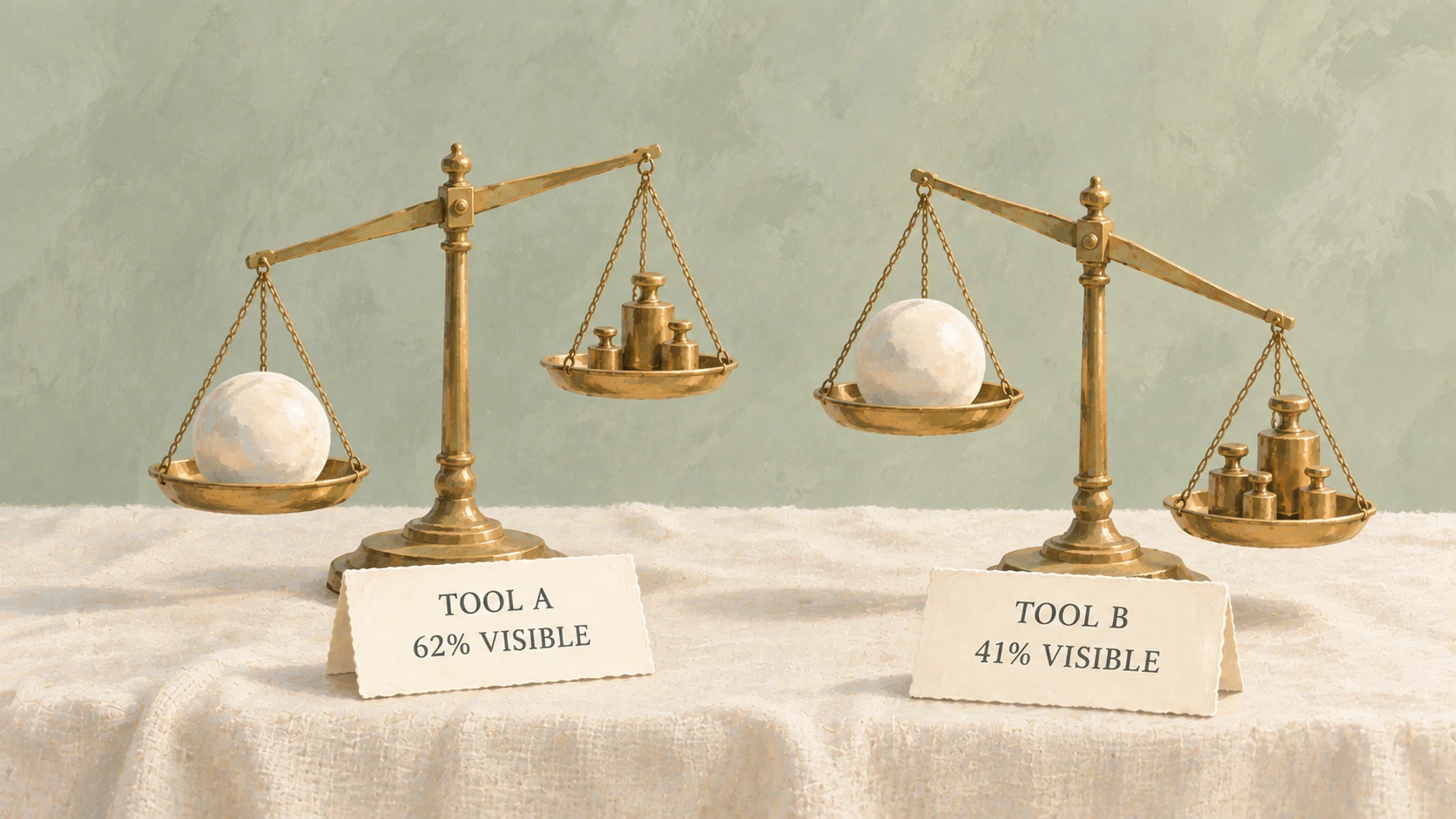
Table of Contents
- The math behind a visibility score
- Why two visibility tools disagree about the same site
- Four causes of a drop that look identical on the chart
- The traffic your visibility score never sees
- How often should you check the score?
- Does a search engine visibility tool measure AI search?
- Building a baseline you can actually defend
Your visibility score drops six points overnight. No deploy went out, no backlinks disappeared, no manual action landed in Search Console. That gap between what a search engine visibility tool reports and what actually happened to your site is why most people quietly stop trusting the number after a month or two.
Visibility is not a Google metric. Google never publishes it. It is a calculation each vendor builds on top of its own rank data, and the assumptions buried in that calculation decide whether the score is a useful early warning or just noise with a nice gradient on it. Here is what sits under the hood and how to read the chart without chasing ghosts.
The math behind a visibility score
Nearly every search engine visibility tool builds its score the same three-step way, even when vendors describe it in different language.
- Start with a keyword set. Either the keywords you explicitly track, or a database of keywords the tool already knows your domain ranks for. This choice matters more than anything else in the formula.
- Convert each position into an expected click share. Position one is worth far more than position five, so raw rank gets mapped through a click-through-rate curve. Published click-curve studies consistently show the drop from the top of page one to the bottom is steep, and that almost nobody goes past the first page. Those curves are where the steep weighting comes from.
- Weight by search volume, then normalize. A move from position 9 to position 4 on a 12,000-a-month keyword should outweigh the same move on a 40-a-month keyword. The weighted total is then expressed against a theoretical maximum, so 100 percent means ranking first for every keyword in the set.
Imagine a 30-keyword set where one term carries 10,000 monthly searches and the other 29 average 50. That single term can own more than half the score. When it slides from 4 to 8, the chart falls off a cliff while 29 keywords sat perfectly still. Nothing broke. The weighting simply did what you told it to do.
Why two visibility tools disagree about the same site
Run the same domain through two search engine visibility tools on the same morning and you will often see scores that differ by 20 points or more. Neither one is lying. They are answering slightly different questions.
| Variable | How it moves the score |
|---|---|
| Keyword set | A curated 50-keyword list behaves nothing like a 4,000-keyword database pull. Curated sets swing hard on single rankings. |
| Brand keywords included or excluded | Your own brand terms usually rank first and carry real volume, so leaving them in can inflate the score and mask non-brand decline. |
| Location and device | A desktop check from a national default versus a mobile check from a specific city returns genuinely different SERPs. |
| Refresh cadence | Daily tracking against a weekly or monthly database crawl means one tool is reporting last Tuesday's SERP. |
| CTR model | Each vendor uses its own click curve, and most do not publish it. Some publish their SERP database size while keeping the formula private. |
The practical conclusion: never compare your score in one tool to a competitor's score quoted from another. Compare a score only to its own history, from the same keyword set, same location, same device.
Four causes of a drop that look identical on the chart
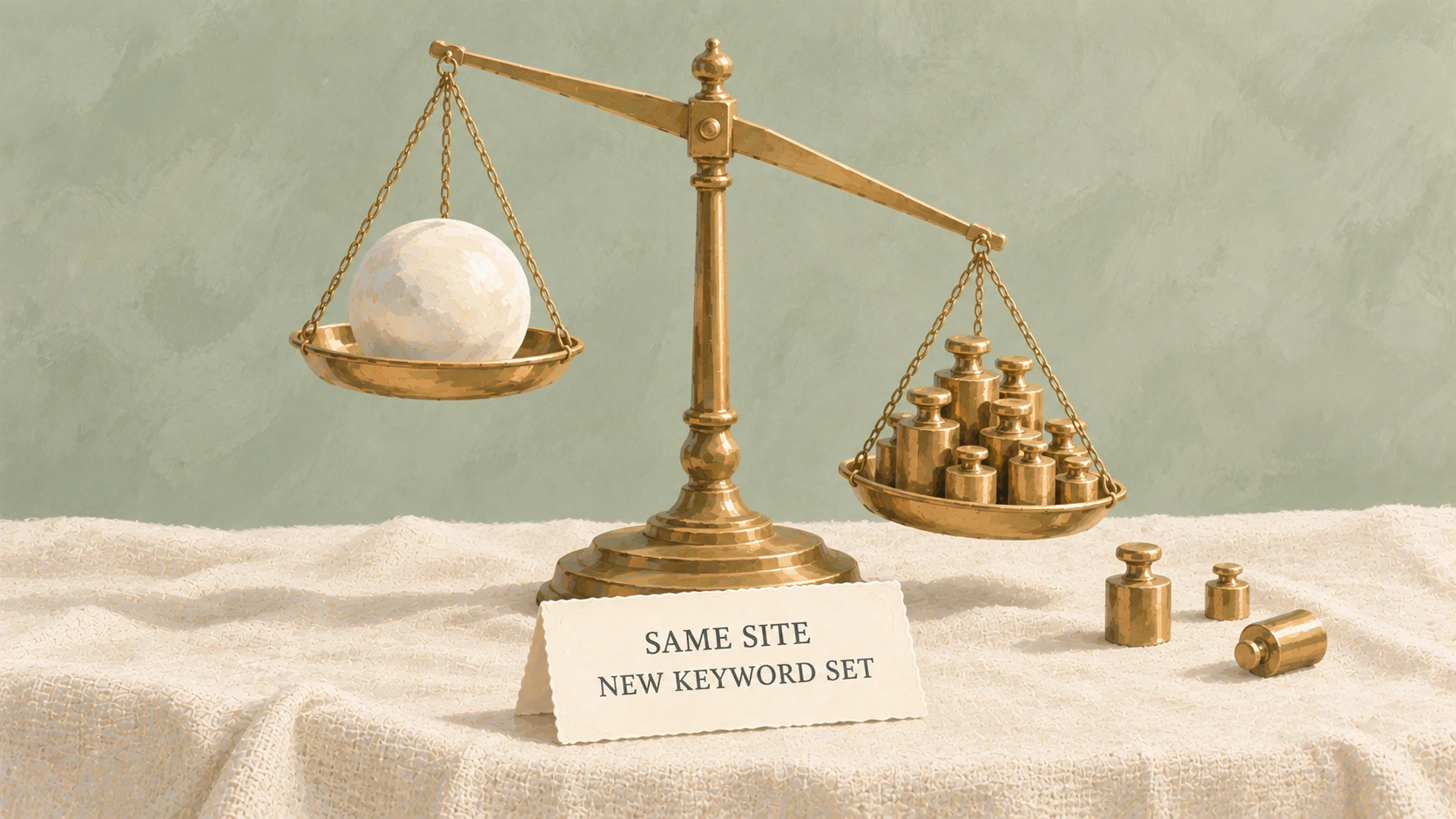
A falling line tells you something changed. It does not tell you what, and the four common causes need completely different responses.
- Real ranking loss. Your positions actually fell. Confirm by sorting tracked keywords by position change over the same window, not by looking at the aggregate.
- Keyword set change. Someone added 200 aspirational keywords you do not rank for yet, or the tool's database refreshed and dropped terms. The denominator moved, not your site.
- Search volume refresh. Volume data updates on a cycle, often monthly. If a high-volume term in your set gets revised down, your weighted score shifts with zero movement in rank.
- SERP layout change. You still hold position three, but an AI Overview, a product carousel, and four ads now sit above it. Rank-based visibility cannot see this, because your position is unchanged.
Work through those four in order before you open an incident. Most alarming drops resolve at step two or three.
The traffic your visibility score never sees
A search engine visibility tool models the clicks you would expect at a given rank under a classic ten-blue-links layout. That layout is no longer what most commercial queries look like. AI Overviews, featured snippets, People Also Ask blocks, and shopping units all push organic results down the page and answer some queries outright, so the searcher never clicks anything.
This produces a specific and confusing pattern: visibility holds flat or even rises while Search Console clicks fall. If you see that divergence, the score is not broken. It is measuring position, and the thing that changed was the page around your position. Pair the score with Search Console impressions and click-through rate for the same keyword set, and the story usually resolves in about ten minutes. Our free SEO score checker covers the on-page side of that picture if you want a second read on a specific URL.
How often should you check the score?
Check it far less often than most dashboards invite you to. Daily checking on a small keyword set trains you to react to sampling noise. A reasonable cadence depends on how much data you have smoothing the average:
- Small sites (under 100 tracked keywords): weekly. Individual rankings dominate the score, so daily movement is mostly noise. Look at four-week trend lines, not day-over-day.
- Mid-size sites (100 to 1,000 keywords): weekly for the trend, with alerts on your top 20 commercial terms so a real loss on a money page surfaces immediately.
- Large sites (1,000-plus keywords): daily is defensible because the volume of data smooths out individual swings, and a genuine sitewide drop shows up as a clean step rather than a jitter.
Whatever you pick, freeze the keyword set between comparisons. A score compared against a different set is not a comparison at all.
Does a search engine visibility tool measure AI search?
Almost never, and it is important not to assume otherwise. A traditional visibility score is computed from ranked positions in the organic results. Being cited inside an AI Overview or quoted by ChatGPT is a separate outcome with separate inputs, and it does not appear in a rank-derived number at all.
That is a growing blind spot rather than a minor footnote, because a brand can be the source an assistant quotes while sitting at position seven, or rank first and go unmentioned entirely. The two need to be tracked side by side. We wrote up how to check the AI side in what AI visibility means and how to check your site, including the four states a brand can occupy in an AI answer.
Building a baseline you can actually defend
Before the next score moves, do four things once so future movement means something:
- Freeze a keyword set and document it. Write down the count, the location, the device, and the date. Note explicitly whether brand terms are in or out.
- Split brand and non-brand into separate views. Non-brand visibility is the number that reflects your SEO work.
- Record which keywords carry the most weight. Usually a handful of high-volume terms drive most of the score. Knowing which ones turns every future drop into a two-minute check instead of an investigation.
- Log the date of every material change. Migrations, template edits, redirect changes, keyword set edits. Half of unexplained drops explain themselves the moment there is a timeline to check them against.
A visibility score is a smoke alarm, not a diagnosis. It is genuinely good at telling you that something moved, and genuinely bad at telling you what. Treat it that way and it earns its place on the dashboard.
CrawlTide tracks rankings and AI visibility in one place, so you can see both the position and the citation for the same keyword instead of stitching two tools together. Start with a free score check and build your baseline from there.
CrawlTide Team
The CrawlTide Team builds and maintains CrawlTide, a platform for technical SEO audits, keyword research, content opportunities, and AI visibility tracking.
Suggested Reading

Free SEO Tools That Stay Free: A Stack Built by Job
A free SEO stack sorted by job, with what each tool asks of you (account, billing details, page caps), including the new free AI search reports in Google Search Console and Bing Webmaster Tools.
8 min read
Schema Markup Examples That Still Earn Rich Results in 2026
Google quietly retired HowTo and FAQ rich results, but most schema guides still recommend them. Here is which markup still renders, by page type, and how to check it before it ships.
9 min read
Schema Markup in SEO: What It Actually Does, and When It Quietly Stops Working
Schema markup in SEO earns rich result eligibility, not rankings. See what Google still renders and why valid markup silently breaks.
7 min read